Introduction
Automating firewall URL whitelisting can save hours of manual work. In this post, we demonstrate how to combine a simple Python wrapper with an Ansible playbook to:
- Search the PAN‑OS logs for blocked URLs.
- Select the URLs to whitelist.
- Add them to an existing Custom URL Category.
- Commit and log the change under a designated Change/Ticket ID.
Prerequisites and Requirements
Create a requirements.txt
requests
pwinput
urllib3
pan-os-python
Install Ansible and Requirements
pip install -r requirements.txt
sudo apt install ansible
ansible-galaxy collection install paloaltonetworks.panos
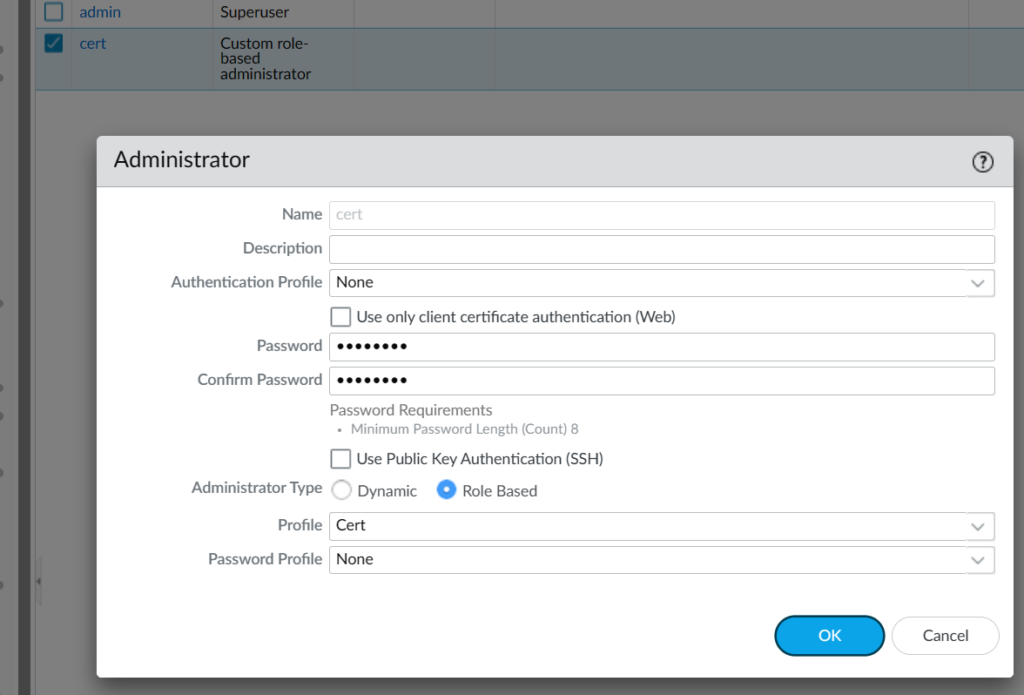
Create RBAC for the API user
- Configuration (URL Filtering / Profiles)
- Operational Requests (type=op)
- Log access (type=log)
- Commit

Script
Create a python file whitelist_url.py
import subprocess
import requests
import pwinput
import urllib3
import time
import xml.etree.ElementTree as ET
from urllib.parse import urlparse

urllib3.disable_warnings(urllib3.exceptions.InsecureRequestWarning)

def get_api_key(firewall_host, username, password):
    url = f"{firewall_host}/api/?type=keygen&user={username}&password={password}"
    resp = requests.get(url, verify=False)
    if resp.status_code == 200 and "<key>" in resp.text:
        return resp.text.split("<key>")[1].split("</key>")[0]
    return None

def get_vsys_list(firewall_host, api_key):
    xpath = "/config/devices/entry/vsys"
    params = {'type': 'config', 'action': 'get', 'xpath': xpath, 'key': api_key}
    resp = requests.get(f"{firewall_host}/api/", params=params, verify=False)
    if resp.status_code != 200:
        print("[ERROR] Failed to retrieve VSYS list.")
        return []
    try:
        root = ET.fromstring(resp.text)
        vsys_parent = root.find('.//vsys')
        if vsys_parent is None:
            return []
        return [e.attrib['name'] for e in vsys_parent.findall('entry')]
    except Exception as e:
        print(f"[ERROR] Parsing VSYS list failed: {e}")
        return []

def extract_blocked_urls(firewall_host, api_key, snippet):
    print(f"[INFO] Searching for blocked URLs matching: {snippet}")
    params = {
        'type': 'log',
        'log-type': 'url',
        'query': f'(url contains "{snippet}") and ((action eq block-continue) or (action eq block-url))',
        'nlogs': '50',
        'key': api_key
    }
    resp = requests.get(f"{firewall_host}/api/", params=params, verify=False)
    if resp.status_code != 200:
        print("[ERROR] Log query failed.")
        return []
    try:
        root = ET.fromstring(resp.text)
        job = root.findtext('.//job')
    except Exception as e:
        print(f"[ERROR] XML parsing error: {e}")
        return []
    if not job:
        print("[ERROR] No job ID received.")
        return []
    for _ in range(10):
        time.sleep(2)
        rp = {'type':'log','action':'get','job-id':job,'key':api_key}
        r = requests.get(f"{firewall_host}/api/", params=rp, verify=False)
        if r.status_code != 200:
            continue
        try:
            rroot = ET.fromstring(r.text)
            domains = set()
            for entry in rroot.findall(".//entry"):
                misc = entry.findtext("misc") or ""
                urlc = misc.strip()
                if not urlc:
                    continue
                if not urlc.startswith("http"):
                    urlc = "https://" + urlc
                host = urlparse(urlc).netloc or urlparse(urlc).path.split("/")[0]
                if host:
                    domains.add(host.lower())
            return sorted(domains)
        except Exception as e:
            print(f"[ERROR] Parsing error: {e}")
            continue
    print("[INFO] No matching logs found.")
    return []

def list_categories(firewall_host, api_key, vsys):
    if vsys == "shared":
        xpath = "/config/shared/profiles/custom-url-category"
    else:
        xpath = f"/config/devices/entry/vsys/entry[@name='{vsys}']/profiles/custom-url-category"
    params = {'type':'config','action':'get','xpath':xpath,'key':api_key}
    resp = requests.get(f"{firewall_host}/api/", params=params, verify=False)
    if resp.status_code != 200:
        print("[ERROR] Failed to load categories.")
        return []
    root = ET.fromstring(resp.text)
    return [e.attrib['name'] for e in root.findall(".//entry")]

def main():
    print("==== Palo Alto URL Whitelisting Tool ====")
    change_id = input("Change/Ticket number: ").strip()
    host_in = input("Firewall hostname or IP (e.g., 10.10.10.10): ").strip()
    fw = host_in if host_in.startswith("http") else f"https://{host_in}"
    user = input("Username: ").strip()
    pwd = pwinput.pwinput("Password: ", mask="*").strip()
    term = input("Search term (e.g., apple or apple.com): ").strip()

    print("\n[INFO] Logging in...")
    key = get_api_key(fw, user, pwd)
    if not key:
        print("[ERROR] Login failed.")
        return

    vsys_list = get_vsys_list(fw, key)
    vsys_list.append("shared")
    if vsys_list:
        print("\nAvailable VSYS:")
        for idx, v in enumerate(vsys_list, 1):
            print(f"[{idx}] {v}")
        sel = input("→ Select VSYS (number): ").strip()
        try:
            vsys = vsys_list[int(sel) - 1]
        except:
            print("[ERROR] Invalid selection, defaulting to 'vsys1'.")
            vsys = "vsys1"
    else:
        print("[INFO] No VSYS found, defaulting to 'vsys1'.")
        vsys = "vsys1"

    domains = extract_blocked_urls(fw, key, term)
    if not domains:
        print("[INFO] No blocked domains found.")
        return
    print("\nBlocked Domains:")
    for i, d in enumerate(domains, 1):
        print(f"[{i}] {d}")
    sel = input("→ Select (e.g. 1,2 or * for all): ").strip()
    if sel == "*":
        chosen = domains
    else:
        try:
            idxs = [int(x)-1 for x in sel.split(",")]
            chosen = [domains[i] for i in idxs if 0 <= i < len(domains)]
        except:
            print("[ERROR] Invalid input.")
            return

    cats = list_categories(fw, key, vsys)
    if not cats:
        print("[ERROR] No categories found.")
        return
    print("\nAvailable Categories:")
    for i, c in enumerate(cats, 1):
        print(f"[{i}] {c}")
    sel = input("→ Select category (number): ").strip()
    try:
        category = cats[int(sel) - 1]
    except:
        print("[ERROR] Invalid category.")
        return

    url_args = ",".join(chosen)
    cmd = [
        "ansible-playbook", "whitelist_url.yml",
        "--extra-vars",
        f"change_id={change_id} ip_address={fw.replace('https://','')} username={user} password={pwd}"
        f" target_url_list='{url_args}' selected_category={category} vsys={vsys}"
    ]

    #print("\n[DEBUG] Running:", " ".join(cmd))
    try:
        subprocess.run(cmd, check=True)
    except subprocess.CalledProcessError as e:
        print("[ERROR] Ansible playbook failed with exit code", e.returncode)

if __name__ == "__main__":
    main()
Create a yml file whitelist_url.yml with:
---
- name: Add URLs to Palo Alto URL Whitelist
  hosts: localhost
  connection: local
  gather_facts: true

  vars:
    provider:
      ip_address: "{{ ip_address }}"
      username: "{{ username }}"
      password: "{{ password }}"
    url_entries: >
      {{
        target_url_list.split(",") |
        map('regex_replace', '^', '') |
        map('regex_replace', '$', '/') |
        list +
        target_url_list.split(",") |
        map('regex_replace', '^', '*.') |
        map('regex_replace', '$', '/') |
        list
      }}
    log_file: "whitelist_log_{{ change_id }}.log"

  tasks:

    - name: Gather existing URL category
      paloaltonetworks.panos.panos_custom_url_category:
        provider: "{{ provider }}"
        name: "{{ selected_category }}"
        vsys: "{{ vsys }}"
        state: gathered
      register: current_category

    - name: Merge new URLs into category
      paloaltonetworks.panos.panos_custom_url_category:
        provider: "{{ provider }}"
        name: "{{ selected_category }}"
        vsys: "{{ vsys }}"
        url_value: "{{ (current_category.url_value | default([])) + url_entries | unique }}"
        type: "URL List"
        state: merged
      register: update_result

    - name: Commit configuration changes
      paloaltonetworks.panos.panos_commit_firewall:
        provider: "{{ provider }}"
      register: commit_result
      when: update_result.changed                                              # only commit if URLs were added :contentReference[oaicite:0]{index=0}

    - name: Write change log
      copy:
        content: |
          Change ID: {{ change_id }}
          User: {{ username }}
          Category: {{ selected_category }}
          Added URLs:
          {% for entry in url_entries %}
            - {{ entry }}
          {% endfor %}
          Commit Job ID: {{ commit_result.jobid | default('n/a') }}
        dest: "{{ log_file }}"
      when: update_result.changed                                              # only write log if we committed :contentReference[oaicite:1]{index=1}

    - name: No changes to commit, skipping
      debug:
        msg: "No new URLs were added; skipping commit."
      when: not update_result.changed                                        # helpful feedback if nothing changed :contentReference[oaicite:2]{index=2}
Usage
Run the Python wrapper
python3 whitelist_url.py
Follow prompts
- Change/Ticket number
- Firewall hostname or IP
- Username & password (input is masked)
- Search term for blocked URLs
- VSYS selection (or defaults to
vsys1/shared) - URL category selection
Ansible playbook runs automatically and produces a log file named whitelist_log_<ChangeID>.log.
Example
Blocked category stock-advice-and-tolls

Test website in this category

Run script

Check logs and firewall config


Conclusion
This automation reduces manual CLI work and standardises whitelisting changes with proper logging. Fork the Git repo, tweak to your environment, and enjoy a faster firewall workflow!